
I do feel it’s worth noting that killing Jack doesn’t actually save the world. It just delays the issue, allowing another 15 or so years for humanity to prepare.
Tag: 12.5p1
Now watch as I turn out to be wrong about Taylor’s decision and half the stuff I said in that last post becomes irrelevant…
So here’s the thing.
Taylor’s trolley problem doesn’t look like this:

It looks like this:
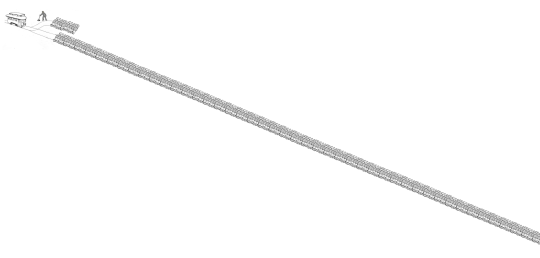
I’m not sure upping the scale like this without balancing the options against each other does the dilemma any favors. It just makes Taylor appear far more selfish if she chooses to send the trolley down the lower line, which I believe she will.
Unless I’m wrong about that, this is what sets Taylor apart from the archetypal super good hero (not to be confused with a typical Worm superhero) – a strong touch of selfishness in her heroic actions. She’s not actually interested in the greater good, only protecting those specific people she personally considers herself responsible for: Dinah, Danny, her team, her territory and – arbitrarily – Charlotte.
I’m not saying this is necessarily a bad thing, though. I’ve been getting on Taylor’s case for focusing too much on Dinah and not being selfish enough. I don’t want to put the burden on her of having feel the same way about the whole world’s population as she does about the people she’s in a position to actually help.
No, this is something that goes beyond Taylor. This is why the archetypal super good hero who cares only about the greater good and saving as many lives as possible is not to be confused with a Worm hero. Worm heroes (and villains) are allowed to have the “flaw” of valuing some few people’s lives above many others, which makes them realistic.
(I think the closest we’ve seen to the archetype is Amy, but she’s not actually like that – she just feels like people expect her to be. I suppose Scion might actually fit, given his activity, but we don’t know much of what’s up with him yet.)
But yeah, from what I know about Taylor and the way this section is written, I feel fairly confident that she is not going to attack the Nine. With that as a foregone conclusion, making the dilemma less balanced – ten versus 2.3 to 6.6912 billion, instead of one versus five – doesn’t make it a tougher moral dilemma for the reader to consider, but rather a device that emphasizes characterization by showing how even with these overwhelming odds, Taylor picks the few she cares about over literally 33-96% of the population.

If it was just my life at stake, a part of me hoped I might do it anyways. But it wasn’t. Others would pay the price if I got away from Siberian, and maybe even if I didn’t.
Yes, but not nearly as many as will pay the price if she doesn’t do this.
Which I don’t think she will. That would surprise me, and not just because of Jack’s plot armor (which may have been taken off in Interlude 11b).
Even if I escaped and Siberian didn’t get her hands on any of us, the added distraction and detours that came with evading her would probably mean I couldn’t make it to my dad in time. And if I did die, Dinah might never go free.
It’s sad that Dinah almost seems to be Taylor’s primary reason to care about her own life.
Which only led to the greater question: would I be willing to trade ten lives for the hundreds or thousands those members of the Slaughterhouse Nine might potentially kill if they walked away here? The billions, if Dinah’s prediction about Jack came true?
And here I thought we finished the trolley problem last chapter. But I suppose Taylor got off easy then, not having to choose herself.
Oh, and I suppose not being able to fly also means gravity is exempt from Siberian’s ability to deny forces from applying to herself. Though turning off gravity would be more like super-jumping than flying, that would still apply to the Triumvirate fights as a way to get high enough to hit them.
And hey, even besides the usual flexibility of powers (like how glass powers may or may not affect sand), that can be explained by the fact that not all models interpret gravity as a force. General relativity, for example, famously interprets it as curvatures in spacetime instead.
By the way, I do think that with the forces she can deny, it’s not an on/off “forces apply to me” vs. “forces don’t apply to me”, but rather a flexible thing where she can pick and choose which forces do still apply. Otherwise, she wouldn’t be able to walk/run while her power was active, as the reaction to her pushing against the ground wouldn’t push her forward.
But I wouldn’t be able to kill Siberian. She’d fought Alexandria, Legend and Eidolon at the same time and walked away unscathed. She hadn’t been able to hurt them due to her inability to fly, but she’d still survived.
Confirmation that she can’t ignore the first law of motion, only the second (I previously mentioned her ignoring the third too, but I’ve realized that was just a consequence of ignoring the second).
More to the point, she can treat incoming forces like they’re not there, but she can’t make her body move like there are forces acting on her that actually aren’t there.
If I attacked Jack, she would come after me and I’d probably die. Would it even work? Bonesaw was a medical tinker. She could theoretically save all three of them. Then I’d accomplish nothing but getting the Nine pissed off at me.
That’s why you’d go after Bonesaw first.
I could kill them right now.
The Nine?
It would be so easy. Jack, Bonesaw and Cherish were all in my range. I could drop poisonous spiders on them, sting them each with dozens of bees and wasps in the hopes of provoking anaphylactic shock.
Ohh, she was being literal. She has the ability to kill them, she’s not just expressing a restrained desire to.
Honestly, I think the only one who’s going to stand in Taylor’s way here is herself. And maybe the threat of revenge from other Slaughterhouse members, but I think it’s going to be primarily a part of Taylor’s mind that doesn’t want her to become a killer, even if the people she killed were mass murderers who have killed and would continue to kill tons of innocent people.
That’s already a strenuous argument before you consider the standing order of “kill or the world ends sooner” on Jack Slash in particular.
But there’s another thing too: This brings us right back to Arc 11 and the topic of bystanderism again, because it forces us to ask if Skitter is already a killer. Did she kill that one wounded Merchant, Thomas, by leaving him to die, or does that not count?
I don’t think it quite counts, but it’s still relevant to the argument, and I think Taylor might look at it differently than I do.
It would be easy, and I might save the world by doing it. I’d get revenge for the countless people they’d murdered, for their attacking Tattletale, and maybe even save hundreds of people’s lives by distracting Shatterbird.
And by preventing them from personally killing tons of people later.
As much as I like these villains, when it comes to this moral dilemma, I’m honestly very much in favor of killing them.
victory mass compartmentalize warn hydrokinesis defense waterlogged antidisestablishmentarianism
Plague 12.5
Hello, everybody! This is the guy who reads the thing, back to do more of that!
Last time, our main girl had to leave a hurt friend behind and run off to tell other people, like her dad and the people she decides over, about the fact that the glass bird is going to do bad stuff to the whole city soon.
This time, I think we’re going to see how that goes for her, and probably get a first look at how much of a hurt the glass bird makes. I hope she actually finds her dad and we get to see her try to tell him about the trouble without giving away the hidden truth of how she learned about it. Or better yet, forget completely about that and get caught off guard by her dad asking about it.
And then she’s going to have to tell the people in her area about it. That’s a lot of people, but she has a lot of small creatures, so she might be able to tell them in a way at least some of them will accept. She doesn’t have time to ask them all to come to one place so she can tell them in person, which would be the best at making people go and be safe.
In the bit at the end of last time, I also talked about Tiny-Run using her small creatures to lower the hurt done by the glass bird, such as by having them be in the way of the glass to slow it down. I still think that’s a thing she might do.
So yeah, without further waiting, let’s stop talking like this and get on with it! 🙂
 Krixwell Liveblogs