Holy crap your hometown looks gorgeous.

Thank you! 🙂

It’s not exactly a big place or a tourist destination (though it does see a fair amount of tourists on their way to other places, which is part of why they’re planning the hotel), but I think it’s a nice little town we’ve got.

The L shape of the clock is the side view.

Oh! So:

The thing on the right is how I imagined it. Bit of a fancy modern design, y’know.

But yeah, I suppose the left design does make a lot more sense with Hebert sensibilities and economy.

The Sarah thing was already known. Coil addresses her as Sarah Livsey in her interlude, and she says she’s willing to answer to either that name or Lisa Wilbourn but prefers Lisa these days.

The “Sarah thing” from that one ask is, I assume, the fact that Lisa was previously named Sarah Livsey, which was revealed back in arc 8. I can’t think of any other Sarah things it could be.

Ahh, right!

Here’s the thing: I remembered well enough that Lisa had changed her name. But I did completely forget what her previous name actually was.

(I know, I’m a disgrace to everyone who calls Lisa their favorite Undersider.)

Given your interest in how stories handle magic, I’d recommend reading the serials Ra and Unsong. Magic is studied as a science in Ra, and it’s puns and wordplay and mass produced office work controlled by large companies in Unsong.

Sounds like bard magic dominates the world in Unsong. And, uh, office worker magic…? Anyway, sounds like fun!

As for Ra, I don’t think “magic is studied as a science” on its own is enough to get me interested in a work, but it is very appropriate to the post I made. I did basically conclude that if magic didn’t naturally work with human ideas, humans would use science to force it to do so to the best of our ability, because humanity as a whole just doesn’t give up on things like this.

A work that I think does neat things with magic is El Goonish Shive. It doesn’t do the sort of thing I was describing in my post – rather the opposite, in fact; EGS magic is explicitly designed to be convenient both to the author and to the characters. But it also has a will of its own, a nonphysical sort-of-entity in charge of how magic works, which doesn’t quite understand humanity because its only direct perception of people is through the magic they use and because it has trouble with subtlety. So while EGS magic is usually convenient and very rarely dangerous, there’s a) a reason it is the way it is (magic is sentient, sapient and trying) and b) a certain disconnect between magic and humanity’s ideas and behaviors.

Oh, and on top of that, there’s a race of ethereal beings (”immortals”) running around and giving people powers for their own varying purposes. Turns out there’s a lot of plot you can be at the root of even while restricted by law to “guide and empower”.

It also significantly features magitech and magic science, especially around one main character in particular.

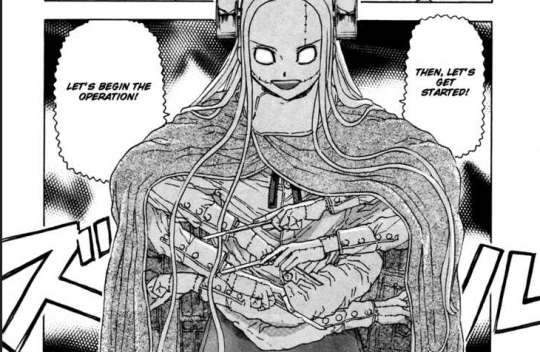
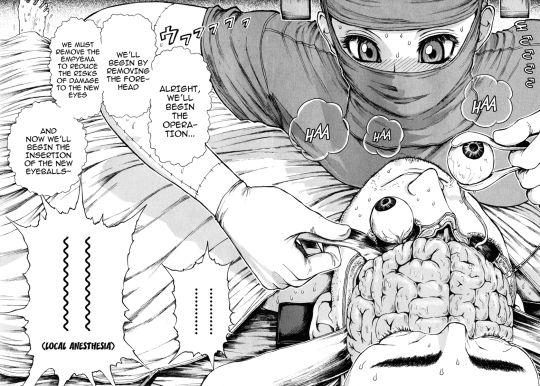
In an alternative universe, bonesaw is known as franken fran

Ahaha, looks about right!

This manga seems like a lot of fun, I think I might read it. 🙂

And hey, look who else makes an appearance:

It’s Buzz 7.3 Skitter!

I’ve been waiting to say this until it took effect. The full quote from TV Tropes (item 4 on the “here’s what I know about Worm going in” list from your intro post) actually goes like this: “Over the first few plot arcs, though, the story shifts away from the hellish landscape that is contemporary high school towards the more uplifting setting of a bombed out city at the mercy of a roving band of psychopaths.” And now it’s there.

Hah, nice!

I didn’t know it was a TVTropes quote – I only knew of it because Sharks said it while recommending Worm. But in retrospect, it really does sound like something TVTropes would say about this story. 😛

I think it’s going to be fun to check out TVTropes’ Worm page(s) if TVTropes still exists when I finish Ward.

Your recent post about “magic that doesn’t follow human ideas” made me think of a webcomic called Triangle and Robert that I read years back. The magic there doesn’t /really/ fit what you’re talking about, but I figure a magic system based around the four food groups (grain, meat, vegetable, dairy) instead of the four elements might be non-traditional enough to spark your interest somewhat. Possibly worth thinking about as fodder for a future liveblog?

Huh. That’s certainly an interesting approach to it!

Glass and sand are both made of silicon dum-dum.

Sand and glass are essentially the same thing, just in different forms. Shatterbird can affect all forms of silicon from glass to quartz sand.

I mean, yeah, I know that glass is made from sand and is essentially just another form of it, but it’s a superpower we’re talking about. Magic by another name. Without testing/exposition, you never really know what sort of limits there are going to be, at what point the power is going to say “no, this is similar but it isn’t in my job description”.

So I’m absolutely fine with Shatterbird being able to control sand – I only questioned it in the sense of “oh, it extends to this form too?” – but I don’t think it would be any weirder for someone to have a power over glass and not have it extend to sand.

Hell, in most other settings, I would consider that more likely because magic doesn’t usually care about chemical composition and stuff like that, or include crabs and such alongside insects. Worm’s powers are a little different from the norm of magic in fiction because it doesn’t quite follow human categorizations and ideas.

“It was the strip of cloth that made the upper part and front leg of the letter R.” It took me a few seconds to understand but then I giggled for like ten seconds straight. I’m still having little burts of laugther.

Hehe, I’m glad you appreciated that! :p